



See how simple it is to apply SANTYL Ointment
Step-by-step application
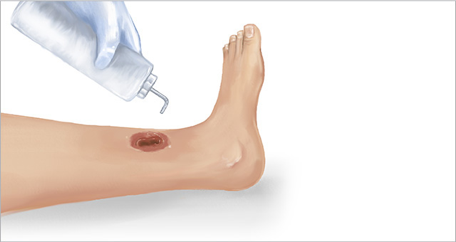
1. Moisture balance
- Wounds with sufficient moisture will naturally activate collagenase enzyme
- Wounds heal better in a moist environment
- Nerve endings are protected by moisture24
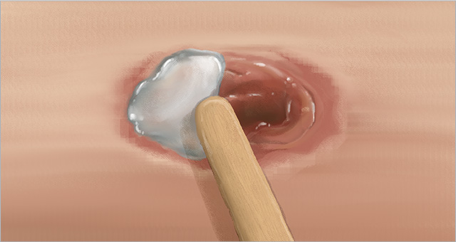
2. Edge to edge
- Apply SANTYL Ointment out to the edges of the wound
- New epithelial and granulation tissue grows from the wound’s edges
- Take care not to extend beyond the wound surface although it does not harm healthy tissue
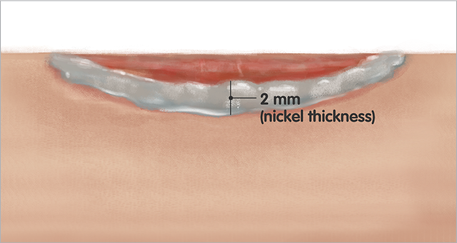
3. Nickel thickness
- Apply once daily at 2mm thickness or about the thickness of a nickel
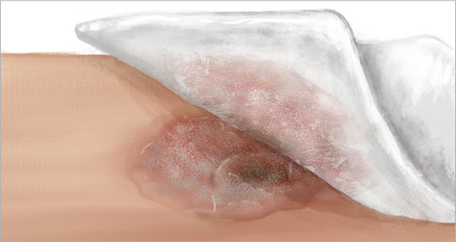
4. Daily dressing change
- Daily dressing changes help remove necrotic burden from wound area to help advance the healing process4
- Moisturize cover dressing with saline if wound is dry and there is no sufficient exudate
- The enzymatic action of SANTYL Ointment may be decreased by dressings containing iodine (I2) and some, but not all, dressings containing silver (Ag)
Compatibility with other products
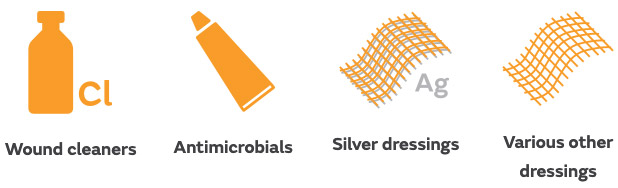
SANTYL Ointment has been tested with cleansers, antimicrobial formulations, and silver dressings21
SANTYL Ointment is compatible with:
- Products that contain alkali metal salts (ie, sodium [Na] or potassium [K]) and earth alkaline metal salts (ie, calcium [Ca] or magnesium [Mg])
- Large non-ionic compounds and non-charged surfactant molecules
- Antimicrobial formulations
- Wound cleansers containing large block co-polymer surfactants (eg, poloxamers) or formulas with dilute sodium hypochlorite
The enzymatic action of SANTYL Ointment is decreased by:
- Dressings containing iodine (I2) and some, but not all, dressings containing silver (Ag)
- Wound cleansers designated to remove impurities, bacteria, and debris
- Antifungal agents and products containing EDTA
For best results:
When using antibiotic powder for infection, apply prior to SANTYL Ointment. If infection persists, discontinue SANTYL Ointment until infection is controlled.
Silver dressings |
Aquacel™ Ag |
 |
|
ALLEVYN♢ Ag |
|
|
Iodine dressings |
IODOFORM™ |
|
Various other dressings |
Hydrofera™ |
|
|
PROSHIELD♢ |
|
|
|
Anasept® Spray |
|
|
Wound cleansers |
Microcyn™ Rx Spray |
|
|
¼-strength Dakin's solution |
|
|
|
Mafenide Acetate |
|
|
Antimicrobials |
Mupirocin |
|
Mode of Action references
- Loveluck J, et al. ePlasty. 2016;16:183-195.
- Galiano RD, et al. PlastReconstr Surg Glob Open. 2018;6(1):e1560.
- Pellino G, et al. Surg Innov. 2014;21(2):204–212.
- Kilpadi DV, et al. Wound Repair Regen. 2011;19(5):588-596.
- Malmsjö M, et al. ePlasty. 2014;14:1-15.
- Ma Z, et al. Exp Ther Med. 2016;11(4):1307-1317.
- Xia CY, et al. Mol Med Rep. 2014;9(5):1749-1754.
- Birke-Sorensen H, et al.. Journal of plastic, reconstructive and aesthetic surgery: JPRAS 64 Suppl, S1–S16 (2011)
- Scalise A, et al. Int Wound J. 2016;13:1260–1281.
- Shim HS, et al. Biomed Res Int. 2018;2018
- R. G, R. D, J. S, et al. The effects of a single use canister-free Negative Pressure Wound Therapy (NPWT) System* on the prevention of post surgical wound complications in patients undergoing bilateral breast reduction surgery. Paperpresented at: The British Association of Aesthetic Plastic Surgeons (BAAP's) 30th Annual Scientific Meeting; 2014; London.
- Hudson DA, Adams KG, Van Huyssteen A, Martin R, Huddleston EM. Simplified negative pressure wound therapy: clinical evaluation of an ultraportable, no-canister system. Int Wound J. 2015;12(2):195-201.
- Kirsner R, Dove C, Reyzelman A, Vayser D, Jaimes H. A Prospective, Randomised, Controlled Clinical Trial on the Efficacy of a single-use Negative Pressure Wound Therapy System, compared to Traditional Negative Pressure Wound Therapy in the Treatment of Chronic Ulcers of the Lower Extremities. Wound Repair Regen. 2019;27(5):519 - 529.
- Smith+Nephew 2018.Summary of rountine QA testing on MVP of PICO dressings. 2018. Internal Report. DS/18/153/R.
- Smith+Nephew 2019.Use of Moisture Vapour Permeability* (MVP) and Moisture Vapour Transmission rate** (MVTR) data to support product claims referring to moist wound healing. Internal Report. EO.AWM.PCSgen.001.v2.
- Saxena V, et al. Plast Reconstr Surg. 114:1086–96.
- Borquist O, et al. Annals of Plastic Surgery. 64: 789–93.
- Ichioka S, et al. Wound Rep Regen. 16(3); 460–465.
PICO active incision management references
- Malmsjö M, Huddleston E, Martin R. Biological Effects of a Disposable, Canisterless Negative Pressure Wound Therapy System. ePlasty. 2014;14:1 - 15
- Hudson DA, Adams KG, Van Huyssteen A, Martin R, Huddleston EM. Simplified negative pressure wound therapy: clinical evaluation of an ultraportable, nocanister system. Int Wound J. 2015;12(2):195-201.
- Payne C, Edwards D. Application of the Single Use Negative Pressure Wound Therapy Device (PICO) on a Heterogeneous Group of Surgical and Traumatic Wounds. ePlasty. 2014:152-166.
- Stryja J, Staffa R, Říha D, Stryjová K, Nicielniková K. Cost-effectiveness of negative pressure wound therapy in outpatient setting. Prolekare. 2015;94(8):322 - 328.
- Smith+Nephew November 2018.The Review Of Evidence Supporting The Use Of PICO In Wounds ≥2cm In Depth. Internal Report. EO.AWM.PCS230.001.v2.
- Casey C. Consistent delivery of therapeutic negative pressure levels by a singleuse negative pressure wound therapy system (sNPWT)* in a wound model. Paper presented at: EWMA; 2019; Gothenburg, Sweden
- Smith+Nephew January 2019.Air Leak Tolerance Report: A comparison of PICO v2 (PICO 7 and PICO 14) Devices to PICO vl.6 (PlCO) Devices. Internal Report. RD/19/006.
- Smith+Nephew December 2018.PICO 14 Service Life Testing: 14 Day Device Lifespan. Internal Report. RD/18/132.
- Smith+Nephew 2021.PICO™ Pressure Mapping Study. Internal Report. DS/19/211/R - Part B.
- Smith+Nephew July 2018.PICO 7Y Non-NPWT Wound Model Summary. Internal Report. DS.18.260.R.
- Smith+Nephew 2020.Bacterial barrier testing of the PICO dressing. Internal Report. 2001002.
- Smith+Nephew 2018.Summary of rountine QA testing on MVP of PICO dressings. 2018. Internal Report. DS/18/153/R.
- Gilchrist B, Robinson M, Jaimes H. Performance, safety, and efficacy of a single use negative pressure wound therapy system for surgically closed incision sites and skin grafts: A prospective multi-centre follow-up study. Paper presented at: SAWC; 2020; Virtual
- Sharpe A, Myers D, Searle R. Using single use negative pressure wound therapy for patients with complicated diabetic foot ulcers: an economic perspective. Wounds UK. 2018;14(3):80-137.
- Myers D, Sharpe A. EP549 Service Delivery in Complex DFU Patients using Single Use NPWT - A UK Perspective. Paper presented at: EWMA; 2018; Krakow.
- Hurd T, Gilchrist B. Single use negative pressure wound therapy (sNPWT) in the community management of chronic open wounds deeper than 2cm. Paper presented at: Symposium on Advanced Wound Care/Wound Healing Society Meeting; 2020; Abu Dhabi.
- Kirsner R, Dove C, Reyzelman A, Vayser D, Jaimes H. A Prospective, Randomised, Controlled Clinical Trial on the Efficacy of a single-use Negative Pressure Wound Therapy System, compared to Traditional Negative Pressure Wound Therapy in the Treatment of Chronic Ulcers of the Lower Extremities. Wound Repair Regen. 2019;27(5):519 - 529.
- Wang E, Tang R, Walsh N, et al. Topical negative pressure therapy and compression in the management of venous leg ulcers: a pilot study. Wound Practice and Research 2017;25(1):36-40.
- Smith+Nephew 2020.Negative Pressure Wound Therapy and Pressure Garment Therapy. Internal Report. EO.AWM.PCS261.002.v2.
General references
- Kirsner R,et al Wound Repair Regen. 2019,27(5),519 - 529
- Kirsner RS. et al. Wound Manag & Prev. 2020:66(3):30-36.
- Dowsett C, E’t al. wounds lnternat,onal 2017;8(2):52-58.
- Guest Jf, et al. J Wound Care. 2017;26(6):292-303.
- Fletcher J. et at Wounds UK. 2022. Available at, http://www.pcdsociety.org/resources/details/active-treatment-non-healing-wounds-community
- Nursery research - TSO
- UK survey - citalton TBD
- Smith+Nephew 2018. Internal Report. OS 18.260.R.
- Hurd T. et al. Ostomy Wound Manage 2014;60(3):30-36
- Gilchrist B. et al Performance, safety, and efficacy of a single use negative pressure wound therapy system for surgically closed incision sites and skin grafts: A prospective multi-centre follow-up study. Paper presented at: SWC; 2020.
- Smith+Nephew 2018. Internal Report. RD/18/137.
- Smith+Nephew March 2018. Internal Report, DS.18.066.R.
- Stryja J, et al Prolekare. 2015;94(8):322 - 328.
- Wang E. et al Wound Practice and Research 2017;25(1):36-40.
- Smith+Nephew 2020. lntemal Report. EO.AWM.PC5261.002.v2.
- Smith+Nephew 2018. Internal Report. EO.AWM.PCS230 001.v2.
- Smith+Nephew 2015. Internal Report. ST865 CT09/02.
- Hudson DA., et al. Int Wound J 2015;12(2):195-201
- Payne C., et al. ePlasty. 2014:152-166.
- Casey C., Consistent delivery of therapeutic negative pressure levels by a single use negative pressure wound therapy system (sNPWT)• In a wound model. Paper presented at: EWMA; 2019; Gothenburg, Sweden.
- Smith+Nephew 2019.P ICO Biomechanical Study. Internal Report. DS/19/211/R.
- Malmsjö. et al. ePlasty. 2014;14: l-15.
- Smith+Nephew 2020. Internal Report, 2001002
- Kilpadi DV, et al. Wound Repair Regen. 2011;19(5):588-596.
- Ma Z., et al E,p Ther Med 2016;11(4):1307-1317
- Xia CV., et al Mot Med Rep. 2014;9(5):1749-1754.
- Brownhill VR., et al. Adv Wound Care (New Rochelle) 2020;0(0): l-12.
- Patel A., et al. Comparison of wound closure in chronic lower extremity ulcers between single use negative pressure wound therapy and traditional negative pressure wound therapy: a real world analysis. Paper presented at: National Wound Conference; 2019: Las Vegas, NV, USA
- Hurd T., Gilchrist B., Single use negative pressure wound therapy (sNPWT) in the community management of chronic open wounds deeper than 2cm. Paper presented at: Symposium on Advanced Wound Care/Wound Healing Society Meeting: 2020; Abu Dhabi
- Mcmanus H., et al Bacterial retention within a multi-layered absorbent AIRLOCK’” Technology Single Use Negative Pressure Wound Therapy (sNPWT) dressing. Paper presented at EWMA: 2018; Krakow, Poland,
- Smith+Nephew. 2018. Internal Report. C5DAWM.24.056.
- Smith+Nephew. Internal Report. RD/19/006
- Smith+Nephew. Internal Report RD/18/132.
- Smith+Nephew 2018. Internal Report. DS/18/219/R V2
- Schwartz JA, et al. J Wound care. 2015;24(2).
- Smith+Nephew 2020. Internal Report, EO.AWM.PCS26l 002.v2
- Smith,Nephew 2016. Internal Report. DS.16.179.R.
- Smith+Nephew 2016. Internal Report DS.16.174.A.
- Smith+Nephew 2008. Internal Report. 05/08/062/Rl
- Smith+Nephew 2009. Internal Report DS/08/078/R2
- Smith+Nephew 2008. Internal Report. 05/08/062/R2
- Aicher B, et al. Journal of Vascular Nursing. 2017 Sep 1;35(3):146–56.